



Whatever Happened to the Business Lunch?
21 October 2026
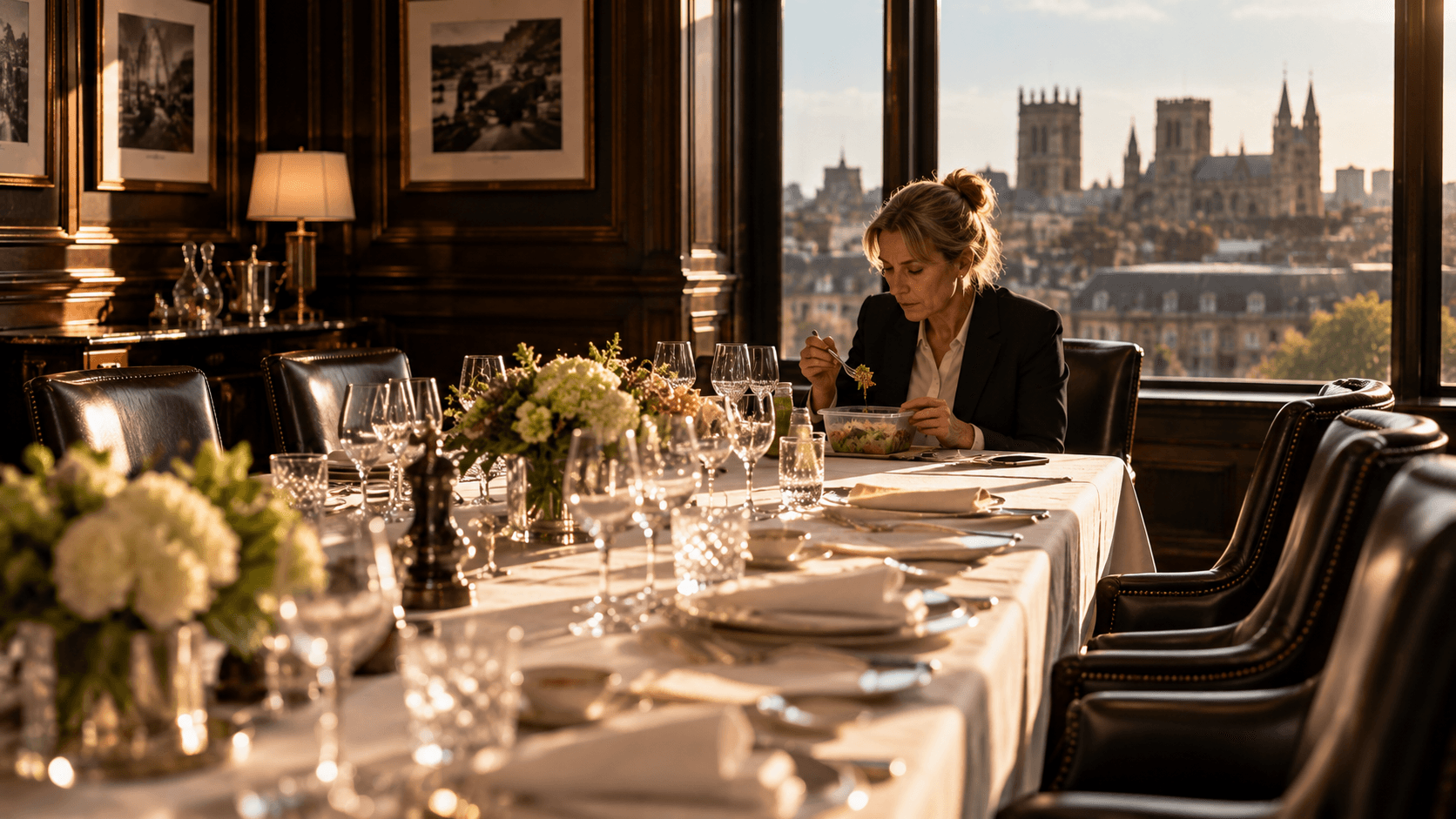
There was a time when doing business meant sitting down for lunch.
Not a sandwich at your desk.
An actual lunch: two people, a table, enough time to talk and, if things went well, another bottle of wine ordered when nobody was ready to leave.
The business lunch acquired a reputation for expense accounts, long periods away from the desk and people charging restaurants to the company card. Then came remote working and a new enthusiasm for at desk productivity.
Suddenly, lunch looked like an indulgence.
Perhaps we were too quick to kill it.
The problem is that we have become very good at confusing efficient communication with useful communication.
A 30-minute Teams call is efficient. You can get through the agenda, make the decision and move on to the next meeting.
But some conversations aren't really about the agenda.
They are about trust. Relationships.
That is particularly true when you are trying to win a client, understand a supplier, recruit someone senior or repair a relationship that has become slightly strained. People reveal rather more about themselves when they aren't staring at a laptop waiting for the meeting to end.
Lunch creates time without quite announcing that time has been created.
You sit down at 12.30. You order. You talk. The conversation wanders. Someone tells you about a problem they haven't mentioned in the boardroom.
None of this looks productive on a spreadsheet.
It can be extremely productive in business.
There is also something to be said for the absence of a screen.
Hybrid working has changed that. If you are only in the office two or three days a week, meeting someone for lunch requires actual planning. That may make the modern business lunch more valuable rather than less.
You have chosen to leave the office, travel somewhere and spend an hour with another human being.
You probably have a reason.
The economics have changed, too. A business lunch is no longer something most companies can treat casually. Hospitality costs money, and professionals are increasingly expected to justify expenditure. Recent business guidance has begun making precisely this argument: client hospitality should be treated as a genuine commercial cost, with sensible policies rather than informal expense-account culture.
Some business investments are difficult to measure because the return arrives later. A conversation today might become a contract next year.
A supplier relationship might save a company from a disaster nobody has yet anticipated.
A lunch with an employee might reveal that they are about to leave.
A meal with someone you've known for ten years might produce an introduction that changes the business.
None of these things fit neatly into a CRM system.
But that's exactly why they matter.
It's true that nobody really needs a three-hour lunch to discuss a 20-minute problem. But the idea behind it remains remarkably relevant.
Get away from the screen. Sit opposite someone. Talk properly.
And, occasionally, allow a business conversation to become something other than business.
The modern workplace has spent years making communication faster.
Perhaps what we need now is to make some of it slower again?